
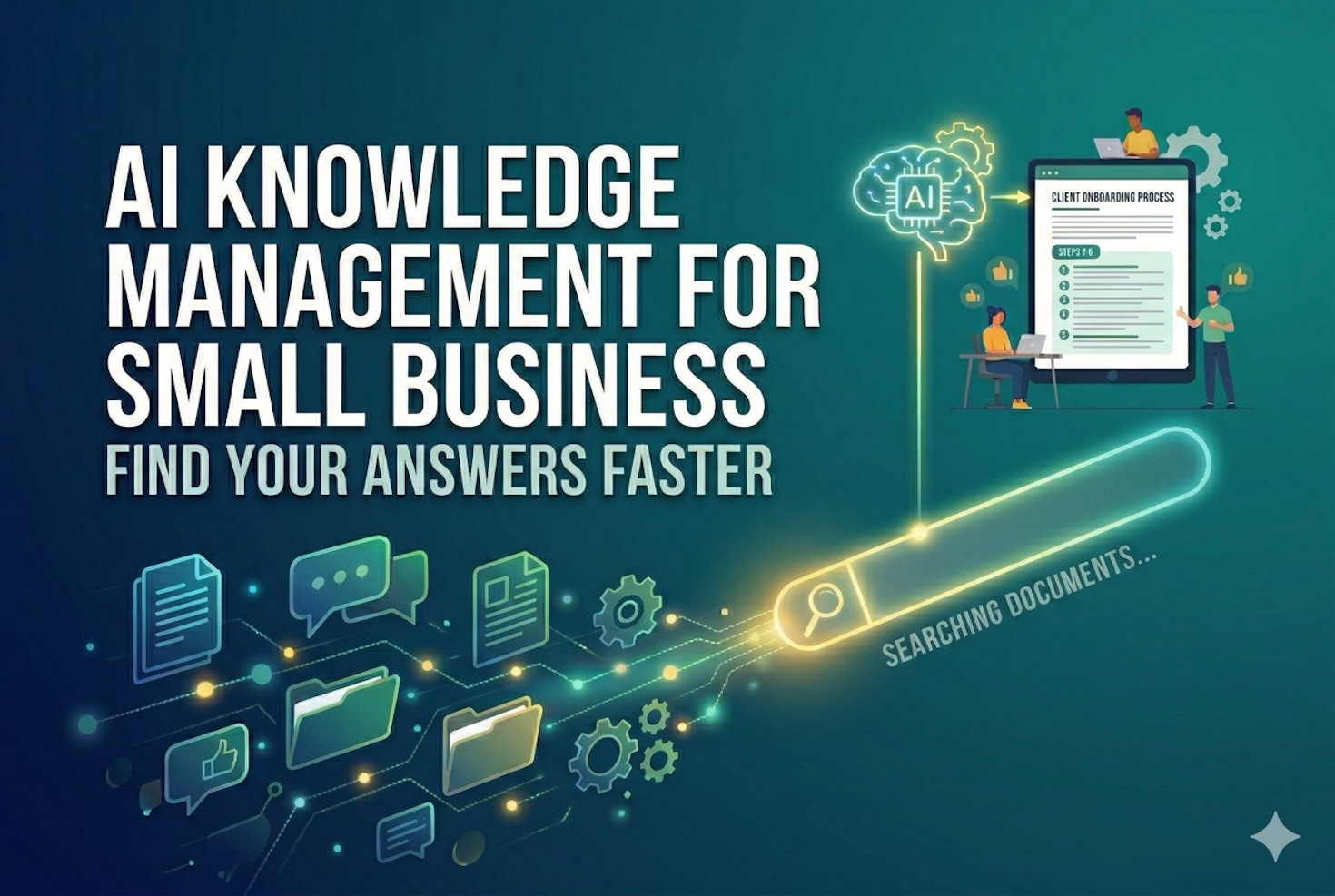
Your ops person is on vacation. A process-critical question lands on your desk. You search your shared drives, dig through Slack threads, and end up calling someone’s personal number. The answer exists somewhere—in documentation, old emails, or someone’s memory—but finding it costs you an hour.
This is the knowledge crisis most small businesses don’t have a name for yet. Fortune 500 companies lose $31.5 billion annually to knowledge silos and poor information sharing. For a 10-person team, the impact is proportionally devastating: estimated annual losses exceed $50,000 when you account for the time spent recreating solutions, onboarding delays, and the risk of critical processes existing only in one person’s head.
The gap isn’t knowledge. It’s access.
Why Small Businesses Quietly Lose Organizational Knowledge
Knowledge doesn’t disappear instantly—it leaks. Industry research suggests that roughly 80% of processes at most companies exist only in someone’s memory, undocumented and inaccessible. When that person leaves, on average about 42% of their expertise cannot be filled by a replacement. New hires spend weeks chasing information that should be instant. Your team reinvents solutions that already exist. And the people who hold the knowledge become irreplaceable—not because they’re exceptional, but because no one else can access what they know.
The problem compounds. Knowledge spreads across email inboxes, Slack channels, shared drives, wikis that no one updates, and Google Docs with cryptic names. Someone knows it’s there. But searching for information—even in your own company—becomes guesswork.
This costs real money. 47% of digital workers struggle to find information needed to do their jobs effectively, according to Gartner research. For a 10-person team, that’s nearly five people wasting time daily searching for answers instead of shipping work.
What’s Actually Changed (And Why It Matters Now)
Five years ago, solving this required enterprise budgets: data science teams, infrastructure, months of implementation, and specialized skills. Today it doesn’t.
AI-powered retrieval (called RAG—retrieval-augmented generation) has matured into a technique that works at small-business scale. Unlike generic AI that hallucinates, RAG grounds responses in your actual documents, extracting answers from what you already have. The technology now runs fast, accurately, and affordably.
Document processing has transformed. Modern OCR and AI can scan, extract, and structure messy documents—invoices, forms, emails, past recordings—in hours instead of weeks. Accuracy rivals manual work and costs a fraction of it.
Integration has gotten simpler. You don’t need to migrate everything to a single system. Modern knowledge tools can layer on top of your existing stack: email, Slack, shared drives, notion databases. They make scattered knowledge searchable without forcing a rip-and-replace migration.
For small businesses, this means something new is possible: production-grade knowledge management at small-business speed and price. No data science team required. No six-month pilot. No $500K implementation budget.
How Modern AI Actually Solves This (Without the Technical Jargon)
The approach has four steps, and you’ve probably intuited all of them:
Capture. Systematically extract knowledge from where it currently lives. That’s not just documents—it’s email threads about process decisions, Slack conversations that solved hard problems, recorded calls, even the mental model of a retiring employee. AI scans and organizes this automatically.
Organize. Tag and connect related knowledge. AI spots that “contract renewal” appears in finance processes, legal playbooks, and vendor management. It builds connections you didn’t see manually. The system becomes aware that these are related.
Make searchable. Build the kind of search that actually works. Someone asks “How do we handle contract renewals?” and gets back: the process, the checklist, links to templates, the specific person who owns each step, and relevant past examples.
Keep current. The system continuously ingests new information—new decisions, updated procedures, solved problems. It doesn’t go stale because you automated its feeding.
The Real Barriers (And Why They’re Smaller Than They Look)
“This will take forever to set up.” Building the system takes work upfront—usually 4-12 weeks depending on scope. But the payoff is fast. Most knowledge management implementations see measurable time savings within the first month and recoup their costs in 8-14 months. For some high-value problems (like onboarding or regulatory documentation), ROI appears in weeks.
“Won’t AI just make things up?” Not with RAG. A RAG system is different from a general-purpose chatbot. It answers only from your documents. If the answer doesn’t exist in your knowledge base, it says so. No hallucinations, no plausible-sounding fiction. You trade some sophistication for reliability—exactly the right trade for business-critical information.
“What’s the real cost?” Depends on your starting point. You can start DIY: Notion + OpenAI API runs roughly $50-200/month for a basic setup and is genuinely useful for capturing knowledge. Managed services—where experts design, extract, and deploy a production system—range from $15K-$60K depending on complexity and the volume of knowledge you’re capturing. The middle path: start with DIY, bring in experts to scale.
“Will our team actually use it?” They will, once they see the value. The first time someone finds an answer in 30 seconds instead of asking a colleague, adoption typically sells itself. The barrier is usually knowing what to capture first, not getting buy-in.
Where to Start
Don’t try to capture everything at once. Pick one high-impact domain and do it right.
Audit what you have: Map the knowledge that already exists. Where does it live—email, Slack, documents, people’s heads? What’s critical to operations? What gets asked repeatedly? Prioritize the knowledge that, if lost, would cost the most—in time, risk, or compliance exposure.
Choose your pilot. Start with one process: customer onboarding, vendor management, operational checklists, hiring procedures. Extract the knowledge from multiple sources, structure it, make it searchable, and measure the impact. Track the time saved, the questions answered, the reduction in “ask Jenny” moments. Let this win fund the next project.
Pick your approach: DIY tools give you control and cost less upfront but require ongoing maintenance. Managed services cost more initially but move faster and require less internal overhead. Some companies start DIY, then bring in expert help once they know what they’re building.
The companies that win here aren’t the ones with perfect processes documented from day one. They’re the ones who stop bleeding institutional knowledge and start making existing knowledge findable and actionable.
Frequently Asked Questions About AI Knowledge Management
Is this only for larger companies?
No. The cost per employee actually favors small businesses—you have less historical knowledge to manage and tighter processes. A 15-person firm typically sees faster ROI than a 500-person one.
How long does it take to see results?
Most teams see measurable efficiency gains within 2-4 weeks of launching an AI knowledge management system. Full ROI typically comes within 8-14 months, though the payback period is much shorter (4-6 months) if you’re focused on a single high-value process.
What if we don’t have time to document everything?
You don’t need to. Start with the knowledge that’s highest-value and hardest to replace. As the system proves itself, expanding it becomes easier.
Can we integrate this with our existing tools?
Yes. Modern AI knowledge management systems layer on top of email, Slack, shared drives, and document repositories without forcing you to migrate. They extract knowledge where it lives and make it discoverable from a central search interface.
What happens if knowledge changes?
The system should continuously ingest updates. When a process changes, new documents get added, and the knowledge base stays current. This is why managed systems often outperform DIY—keeping knowledge fresh requires discipline.
Getting AI Right Matters More Than Getting It Fast
If you’re evaluating your options or want a second opinion on how to approach knowledge management for your team, we’re happy to talk. We’ve helped businesses across healthcare, financial services, and other regulated industries turn scattered knowledge into searchable systems that scale with their growth.
The knowledge you need already exists. It just needs to be found.