
By some estimates, more than 80% of AI projects fail to deliver business value — twice the failure rate of non-AI technology projects. And a Gartner survey of 782 I&O leaders released just this week found that only 28% of AI projects in infrastructure and operations fully deliver on their ROI expectations. If teams with dedicated technical resources are struggling at those rates, small and mid-sized businesses face even steeper odds.
But here’s the thing most AI failure articles won’t tell you: the technology usually isn’t the problem. The projects that stall, burn through budget, or quietly get shelved almost always share the same root cause — and it happens before anyone writes a single line of code.
The Problem Isn’t the Technology — It’s the Problem Definition
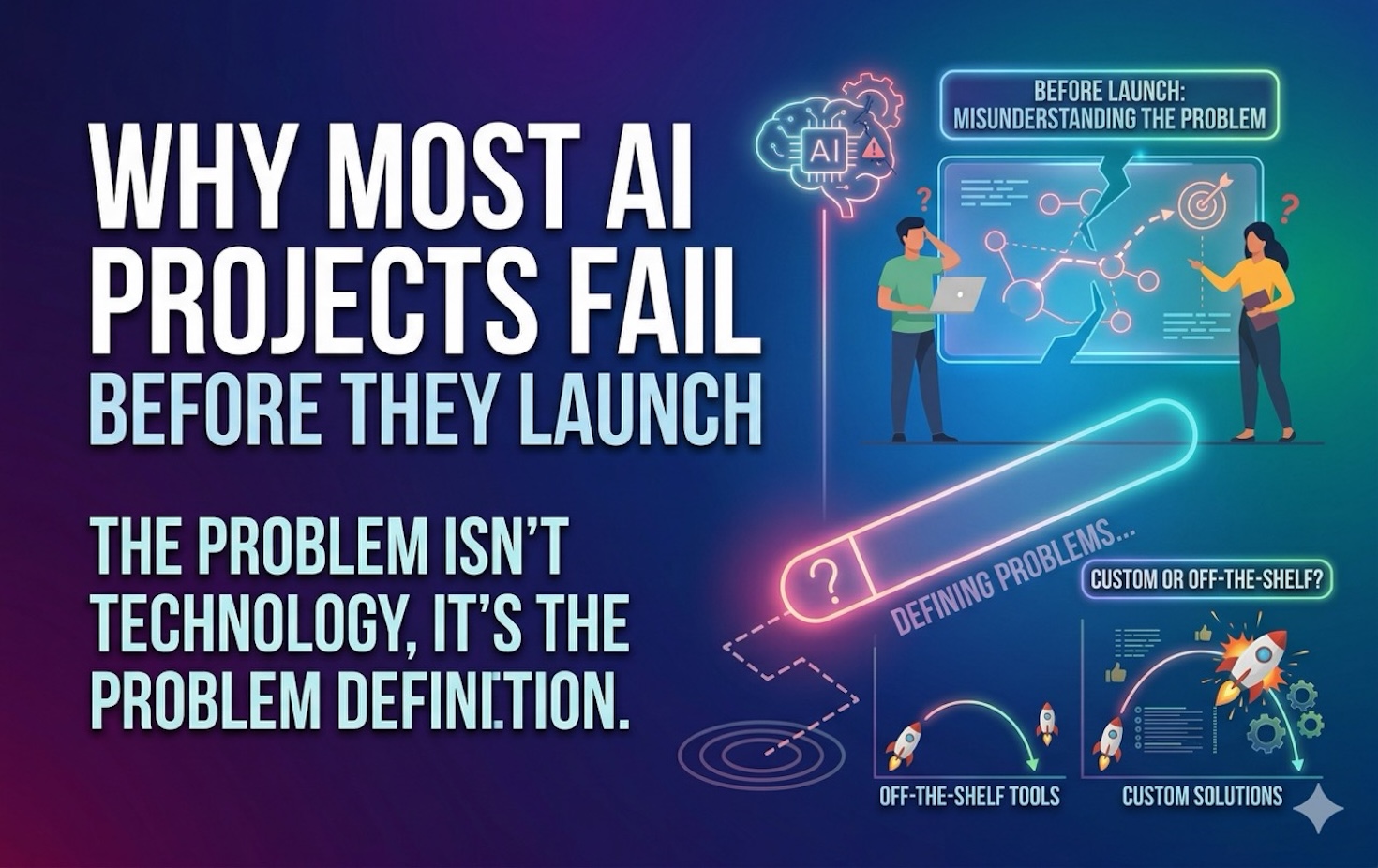
RAND Corporation researchers identified five root causes behind AI project failures, and the first one explains the rest: stakeholders misunderstand or miscommunicate what problem needs to be solved. The technology works. The models are capable. But the project was never aimed at the right target.
This pattern is especially destructive for SMBs because there’s less room for expensive course corrections. A 200-person enterprise can absorb a $150K failed pilot. A 30-person firm can’t — and the political fallout is immediate. One visible failure can kill AI adoption for years.
What makes this so persistent is that it feels productive to skip ahead. A team sees a compelling AI demo, gets excited, and starts building. Three months later they have a technically functional system that nobody uses because it automates a process that wasn’t the actual bottleneck. The Gartner survey confirms this: 57% of failures were traced to organizations expecting too much, too fast — jumping to solutions before understanding constraints.
Why “Start With AI” Is Backwards
The conventional advice is “start small with AI.” That’s fine as far as it goes, but it misses the deeper issue. Starting small with the wrong problem just gives you a small failure instead of a large one.
Consider a 25-person financial advisory firm that decides to automate client report generation. Sounds reasonable — reports take hours. But when you map the actual workflow, the bottleneck isn’t the writing. It’s the data reconciliation across three systems that happens before anyone starts drafting. Automating the report generation saves 20 minutes. Fixing the data pipeline saves 6 hours per week.
The firms that succeed with AI — and BCG research shows only about 5% create substantial value at scale — share a common pattern: they invest in understanding the problem before picking a solution. Top performers allocate roughly 70% of their AI budget to people and processes, and only about 20% to the technology itself. That ratio surprises most business owners, but it’s the clearest signal in the data.
The Gap Between Demos and Real Work
There’s a striking disconnect between what AI can do in a demo and what it can deliver in production. Scale AI’s Remote Labor Index tested frontier AI agents on 240 real freelance projects from Upwork — the kind of multi-step, ambiguous work that actual businesses deal with daily. The best-performing agent completed just 2.5% of projects to a standard a paying client would accept.
That’s not because the AI lacks capability. On structured benchmarks where all context is provided, the same models approach expert-level performance. The gap is between “can AI do this task” and “can AI do this job.” Tasks come with context handed to them. Jobs require the AI to figure out what matters, what’s missing, and what “good” looks like in a specific business context — exactly the kind of judgment that 76% of Americans say they don’t trust AI to provide, according to a recent Quinnipiac University poll.
For SMBs, this means the question isn’t “which AI tool should we buy?” It’s “have we defined the problem clearly enough that any tool — AI or otherwise — could solve it?”
What to Do Before You Spend a Dollar on AI
The most valuable thing you can do this week costs nothing: map your three most time-consuming manual processes end to end. Not the idealized version — the real one, with the workarounds, the tribal knowledge, the steps that exist because “that’s how we’ve always done it.”
Then ask three questions about each process: Where does data get stuck or re-entered? Where do errors cluster? Where does one person’s knowledge become everyone else’s bottleneck?
The answers will tell you whether AI is the right tool — and if so, exactly where to apply it. That clarity is what separates the 28% of projects that deliver ROI from the majority that don’t.
Common Questions About AI Project Failures
Why do AI projects fail more often than other technology projects?
AI projects depend heavily on data quality and clear problem definitions — two things most organizations overestimate. Unlike traditional software where requirements are explicit, AI systems need well-structured training data and measurable success criteria that many teams don’t establish upfront.
How much should a small business expect to spend on its first AI project?
Meaningful AI automation projects for SMBs typically range from $10K-$40K depending on complexity. But the firms that succeed often spend the first 2-4 weeks — and a fraction of that budget — on process mapping and data assessment before any technology work begins.
Is it better to build custom AI solutions or use off-the-shelf tools?
It depends entirely on your problem. If your challenge is well-defined and common (email triage, document summarization, basic data extraction), off-the-shelf tools like Claude or ChatGPT may handle it at a fraction of the cost. Custom solutions make sense when your workflows, data structures, or compliance requirements are genuinely unique — not just familiar.
What’s the biggest mistake SMBs make with AI?
Treating AI as a technology purchase instead of a business transformation. The tool is usually the easiest part. The hard work — defining the right problem, cleaning data, redesigning workflows, and managing change — is where most projects succeed or fail.
Getting AI right matters more than getting it fast. If you’re evaluating your options or want a second opinion on your approach, we’re happy to talk.
Get in Touch